Research

Before we can do any restoration or conservation work, we have to know how our land management decisions affect native biodiversity. We do scientific research to identify the causes of decline in native plants and animals and to figure out the best land management practices to support those species. All of our research projects produce actionable recommendations that inform land managers and conservation practitioners. We have four focal research areas:
You can find summaries of our research projects below and published papers and recordings of research presentations here. Our work is made possible by the support of the Raines Family Fund, the BAND Foundation, and other foundations and individual donors.
Want to get involved? Early in the year we usually hire 1-3 research technicians for the summer. You can find our current openings at cliftoninstitute.org/employment. We also usually accept 1-3 unpaid interns in each season (spring, summer, and fall); you can learn more here. Middle and high school students wanting to conduct their own research can participate in our Young Scientists Research Experience, which we offer every June. Finally, we run four community-science events (counting butterflies, dragonflies twice, and birds) throughout the year. You can learn more here about how to get involved in our community science projects. We also welcome scientists from other institutions to do research at the field station. We have a wide range of habitats and there is very little red tape. Contact us at info@cliftoninstitute.org if you are interested.
Native savannas and grasslands were once widespread in the Piedmont of the eastern Unites States. Most of these habitats have vanished as a result of fire suppression, extirpation of bison, invasion by non-native pasture grasses, and urban development.
Our first goal in studying remnant grasslands in Virginia is to document what plants and animals are found in these habitats. In the summer of 2020, we teamed up with researchers from the Restoration Ecology Lab at Virginia Tech to survey remnant grasslands. We found nearly 500 species of plants, including several rare or threatened species such as Torrey’s Mountain-mint (Pycnanthemum torreyi), Stiff Goldenrod (Solidago rigida), and Yellow Nodding Ladies’ Tresses Orchid (Spiranthes ochroleuca). Amazingly, one of our 50-by-2-meter plots had 93 species of plants, which made it the third most diverse vegetation plot that has been sampled in the state (out of 4,500 surveys)! We also found that most of the high quality grasslands we encountered were in power line clearings (as opposed to pastures, hay fields, or fallow fields). Finally several of the diverse prairies we studied are threatened by invasive plants or urban development. These results were published in 2024. Our research shows how important it is to save these incredible habitats before they disappear. Starting in 2026 we are launching a Grassland Steward program to conserve as many of these sites as possible. This research was funded by the Virginia Native Plant Society.
In addition to conserving existing sites, it’s important to create habitats that are as close as possible to natural plant communities. Our second goal in our grassland research is to figure out how best to restore native grasslands. In 2019 we started a major project to restore 110 acres of overgrazed cattle pasture on our property. In collaboration with Virginia Working Landscapes and the Oak Spring Garden Foundation, we tested eight combinations of methods of establishing native plants and maintaining open habitat methods in order to figure out how best to help declining native species. You can find our preliminary results here. More rigorous results will be published in a peer-reviewed journal by the end of 2026. This project was funded by the Natural Resources Conservation Service, the Oak Spring Garden Foundation, and the Raines Family Fund.
More than 90% of the land in Virginia is privately owned and very little early successional habitat is found on public lands. The conservation of most declining species in the state is therefore in the hands of private landowners. We study how declining species, in particular American Kestrels and Box Turtles, move around our landscape in order to design strategies to reduce their mortality from land management practices, such as hay cutting, grazing, mowing, and prescribed burning.
American Kestrel
American Kestrels are declining across northeastern North America. The decline is poorly understood, but habitat alteration, pesticides, and predation by Cooper’s Hawks are possible causes. One key aspect that has not been investigated in detail is the types of fields that kestrels use for hunting. We wanted to know more about which kinds of agricultural habitats and natural grasslands are most productive as hunting grounds, so that we could provide land owners advice about how to manage their land to help kestrels. Since spring of 2021 we have been working with Dr. Joe Kolowski from the National Zoo’s Smithsonian Conservation Biology Institute and Alan Williams to tag kestrels with GPS transmitters. You can see the locations of tracked birds here! This also us to see what kinds of fields (natural grassland, pasture, row crops) they hunt in. Preliminary results indicate that kestrels prefer cattle pastures over other field types for hunting. There are several recording of presentations about this research here. This research is supported by the Raines Family Fund, the BAND Foundation, Nick Lapham, the Peregrine Fund, the Washington Biologists’ Field Club, the Virginia Society of Ornithology, and Janine Moseley.
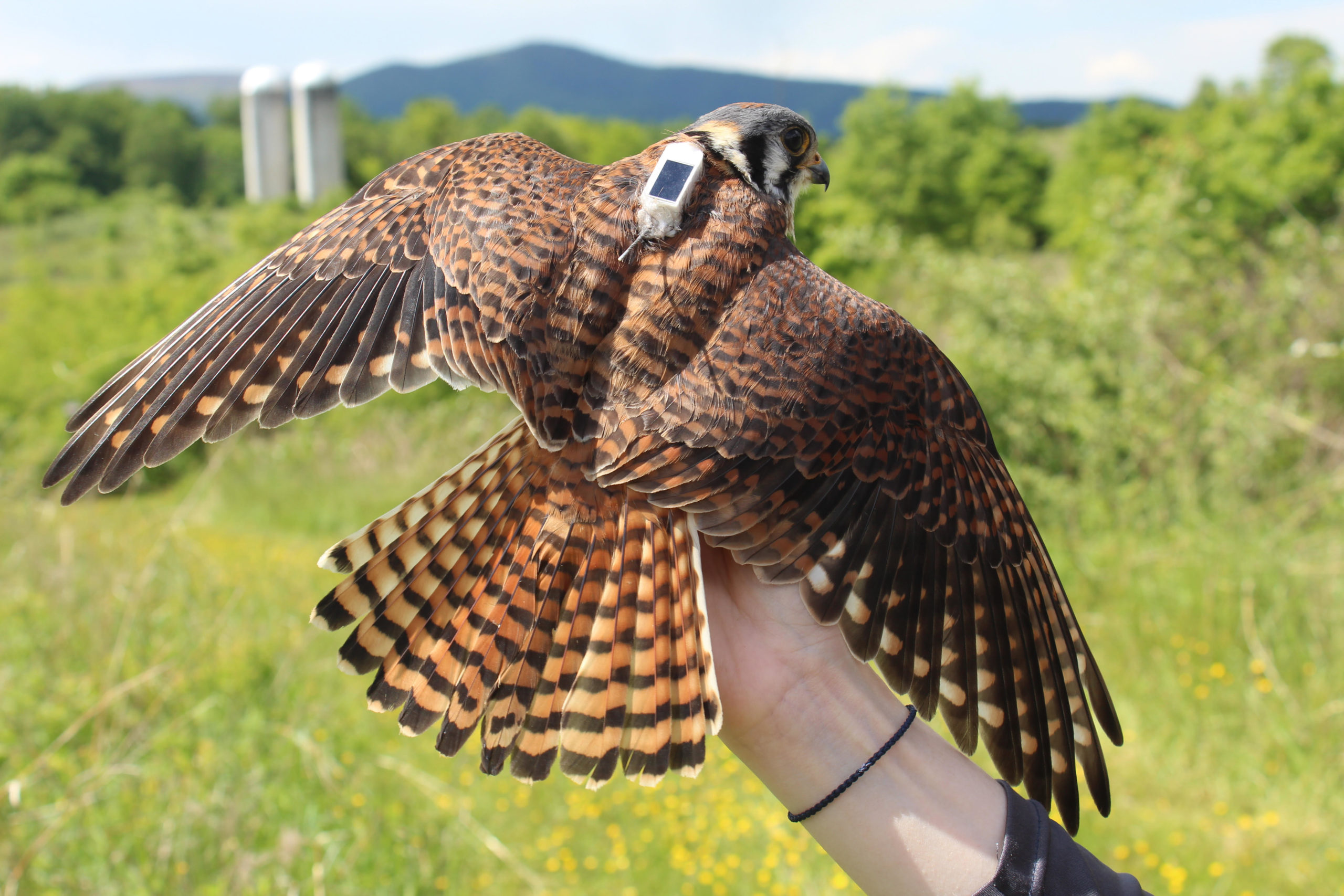
We tag American Kestrels with GPS transmitters to learn which kinds of habitats are the most productive hunting grounds.
Box Turtles
Box Turtle populations in the Mid-Atlantic appear to be in steep decline, and it’s likely that mortality from mowing is a serious threat in rural areas like northern Virginia. Box Turtles live up to 70 years in the wild, they take eight years to reach reproductive age, and their clutches average three eggs, only half of which are usually viable. All of these factors make Box Turtle populations unusually sensitive to adult mortality. There are clear recommendations on how to time mowing in order to minimize grassland bird mortality in the Mid Atlantic, but due to a lack of research, there are no such recommendations for Box Turtles.
In 2022 we teamed up with Dr. Joe Kolowski from the National Zoo’s Smithsonian Conservation Biology Institute and the Turtle Conservation Ecology lab there to study how Box Turtles are doing in our area and to develop mowing guidelines for landowners. Since 2023 we have been tagging Box Turtles in Fauquier and Rappahannock counties with radio tags and GPS transmitters. So far we have found that
This research is supported by the Raines Family Fund, the BAND Foundation, and donors who have adopted a turtle.
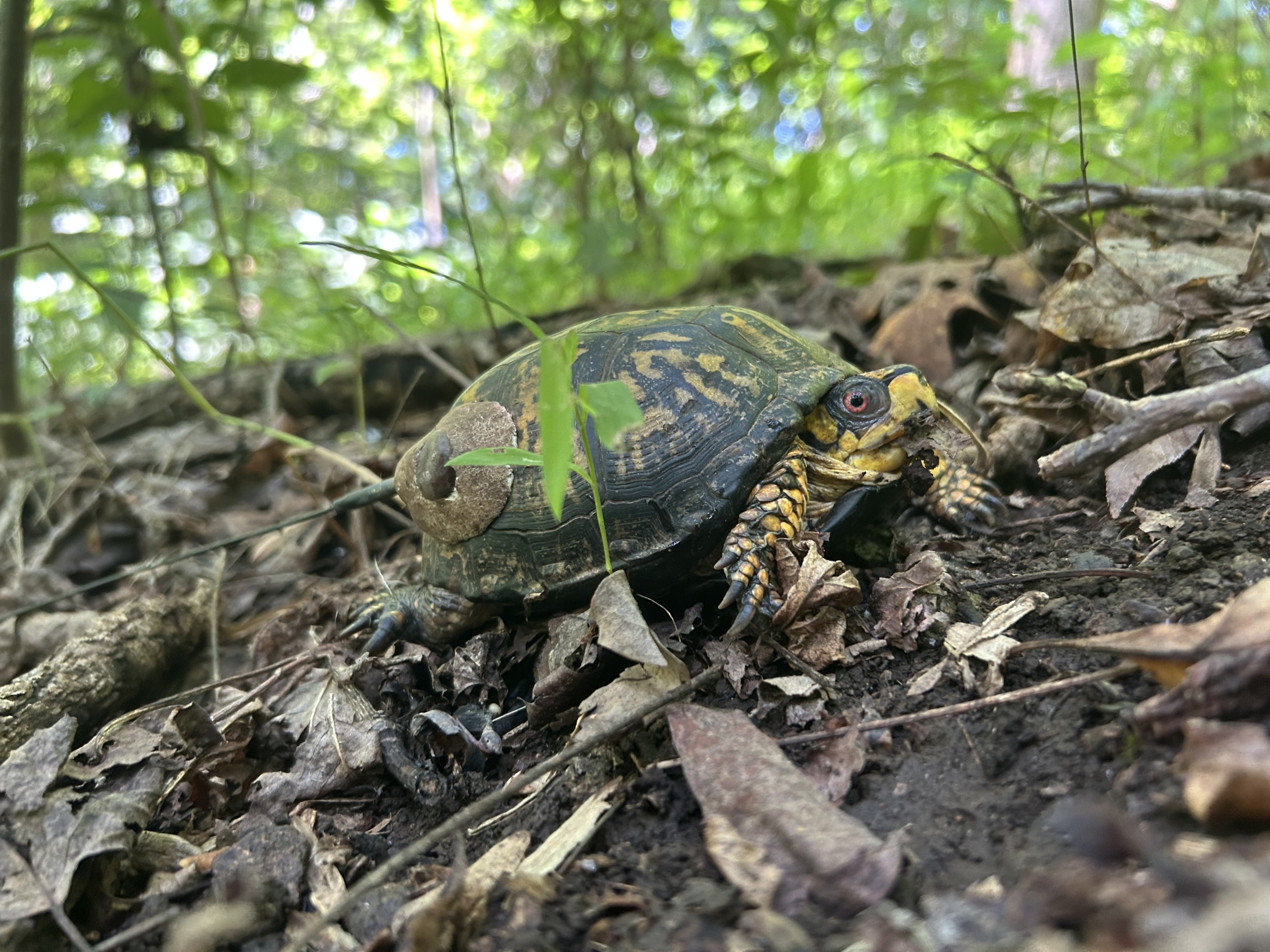
This turtle has been tagged with a radio transmitter that allows us to find him again and again over the course of multiple years.
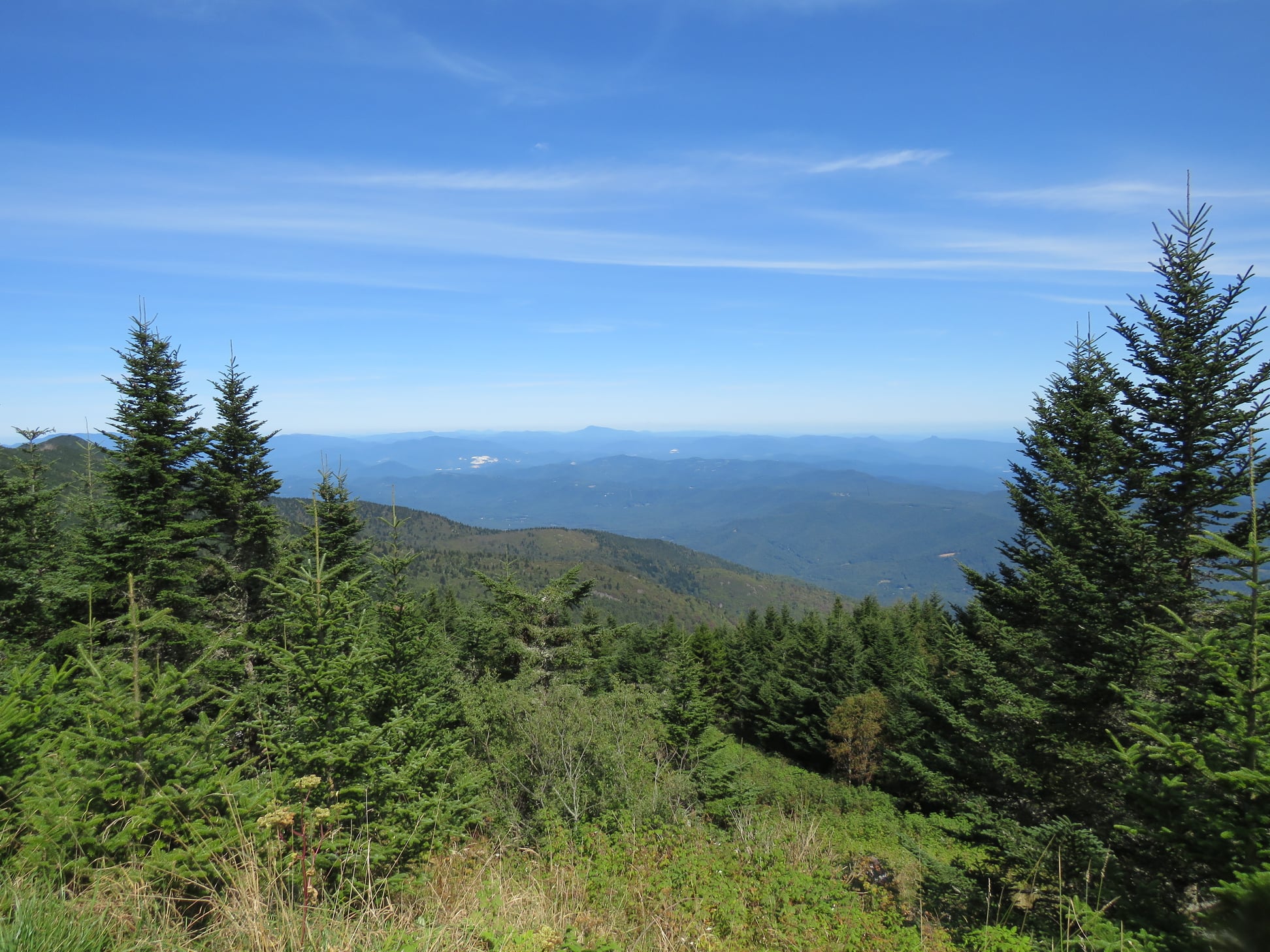
One way that animals may respond to climate change is by moving to higher elevations, where the climate is cooler. Since 2016 our Co-directors, Bert and Eleanor Harris, along with Dr. Brett Scheffers from the University of Florida, have conducting bird surveys from the bottom to the top of Mount Mitchell in North Carolina in order to track changes in the birds’ distribution and abundance as a function of climate change. We complement these bird surveys with plant studies, in order to have a more complete understanding of how the ecosystem is responding to climate change. Our preliminary analyses show that in just ten years Red-breasted Nuthatch and Hermit Thrush have shifted uphill. We expect to find more such species as time goes on.